
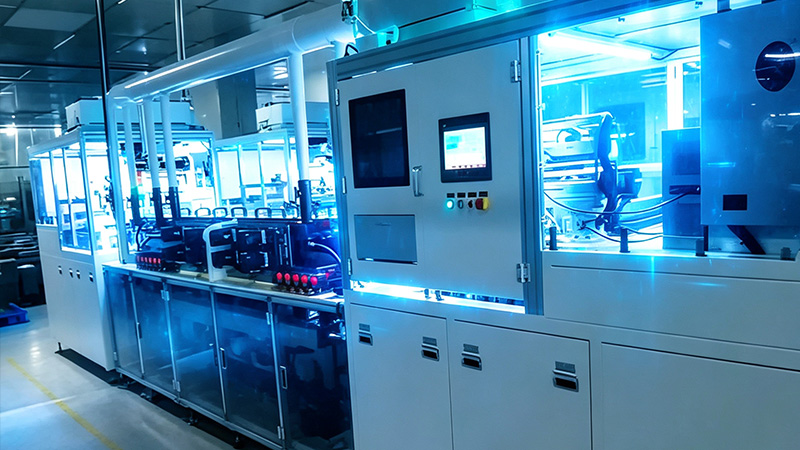
The main products are automatic laminating equipment and high-precision testing solutions.Relying on more than ten years of optical electromechanical and machine vision technology, it has realized high-speed and high-precision bonding and defect detection, served a number of head circuit board manufacturers, and helped improve yield and production efficiency.
The main products are automatic laminating equipment and high-precision testing solutions.Relying on more than ten years of optical electromechanical and machine vision technology, it has realized high-speed and high-precision bonding and defect detection, served a number of head circuit board manufacturers, and helped improve yield and production efficiency.
Conventional coverlay lamination machines operate at limited speeds with insufficient precision, creating severe throughput bottlenecks in high-volume PCB manufacturing and failing to meet the demands of miniaturized, high-density circuit designs.
As PCB line widths shrink below 50μm, legacy vision inspection systems lack the resolution, algorithm sophistication, and optical-electrical integration needed to reliably detect micro-defects such as copper residuals, pinholes, and trace fractures.
When inspection and lamination equipment operate as isolated systems without integrated control and data connectivity, root-cause analysis becomes impossible, and yield fluctuations cannot be traced back to specific process parameters in real time.
PREV
NEXT
The assembly line has a built-in deep learning vision system, which captures defects such as PIN offset, warped feet, missed insertion, and virtual welding in real time, distinguishes between subtle process deviations and real defects, and the detection speed is not reduced by the addition of AI.
Traditional defect classification relies on manual re-judgment.The AI audit system of the PIN intelligent assembly line can automatically learn and adapt, quickly classify and grade defects, reduce misjudgment without slowing down the production line.
The assembly line integrates a high-precision measurement module to accurately measure PIN height, coplanarity, spacing and solder joint morphology.AI-driven contour modeling improves measurement accuracy and reliability, and helps manufacturers control process fluctuations.
AI fully interconnects the various stations, testing equipment and MES systems of the assembly line, drives cross-system data fusion and analysis, and generates real-time process response prediction, dynamic beat optimization, and intelligent production scheduling.
PREV
NEXT
The massive amount of data in the manufacturing process is analyzed in real time through the AI system to gain insight into trend deviations and abnormal patterns, provide full-link traceability, and promote continuous improvement and yield improvement.
AI migrates image processing and data computing to edge GPUs, reducing the hardware cost of traditional industrial computers, while improving computing power density and response speed.
The global service team uses AI predictive maintenance to identify equipment abnormalities in advance and provide customers with faster remote diagnosis and on-site support.
From process programming to daily operation and maintenance, AI automates and optimizes processes in all aspects to improve the efficiency and production capacity of engineers and operators.
PREV
NEXT
The assembly line has a built-in deep learning vision system, which captures defects such as PIN offset, warped feet, missed insertion, and virtual welding in real time, distinguishes between subtle process deviations and real defects, and the detection speed is not reduced by the addition of AI.
Traditional defect classification relies on manual re-judgment.The AI audit system of the PIN intelligent assembly line can automatically learn and adapt, quickly classify and grade defects, reduce misjudgment without slowing down the production line.
The assembly line integrates a high-precision measurement module to accurately measure PIN height, coplanarity, spacing and solder joint morphology.AI-driven contour modeling improves measurement accuracy and reliability, and helps manufacturers control process fluctuations.
AI fully interconnects the various stations, testing equipment and MES systems of the assembly line, drives cross-system data fusion and analysis, and generates real-time process response prediction, dynamic beat optimization, and intelligent production scheduling.
The massive amount of data in the manufacturing process is analyzed in real time through the AI system to gain insight into trend deviations and abnormal patterns, provide full-link traceability, and promote continuous improvement and yield improvement.
AI migrates image processing and data computing to edge GPUs, reducing the hardware cost of traditional industrial computers, while improving computing power density and response speed.
The global service team uses AI predictive maintenance to identify equipment abnormalities in advance and provide customers with faster remote diagnosis and on-site support.
From process programming to daily operation and maintenance, AI automates and optimizes processes in all aspects to improve the efficiency and production capacity of engineers and operators.

 中文
中文
 English


